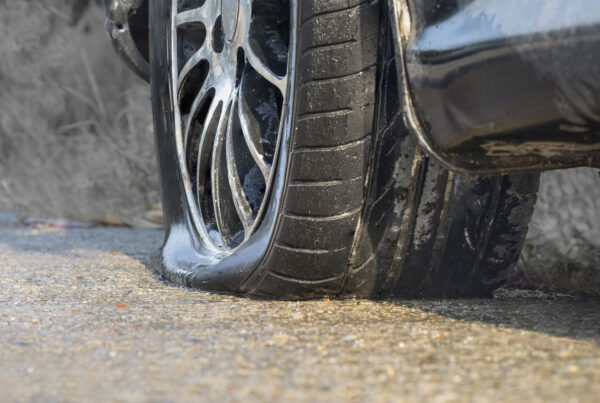
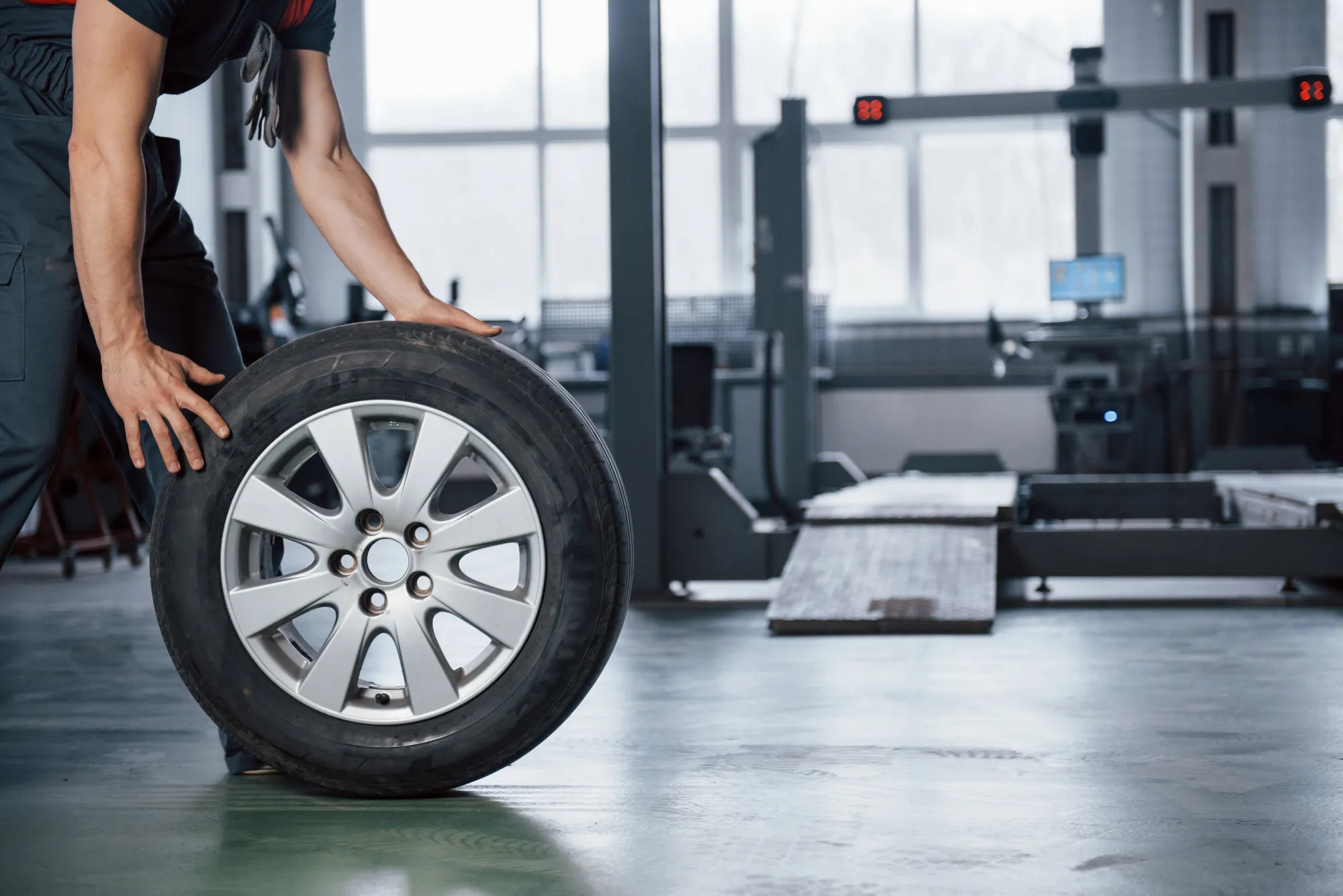
You are standing at our counter in Cleveland with a tire that is not coming back. Maybe a piece of angle iron came off a trailer on I-75, maybe you found the edge of a pothole on a back road in Bradley County, maybe it was a curb you did not see. The tire is done. And the question you ask next is almost always the same one: do I have to buy all four?
The honest answer is that nobody can tell you over the phone. Not us, not the internet, not your brother-in-law. Whether you can replace one tire or need to match the set is not a rule of thumb, it is the result of three measurements a technician takes with your car in the bay. This post walks you through exactly what those measurements are, in the order any good tire shop in Cleveland, TN should take them, so that when you hear “one,” “two,” or “four,” you know where the number came from.
First we find out whether you need to replace the tire at all
Before anybody counts tires, we check whether yours can be repaired. Drivers are often surprised by this. A tire that looked catastrophic on the shoulder of the highway is sometimes perfectly fixable, and one with a nail head barely showing is sometimes not.
The rules here are not ours. They come from the U.S. Tire Manufacturers Association and the Tire Industry Association, and they are about where the injury is and how big it is, not how bad it looks.
- Size. A repairable puncture cannot be larger than 1/4 inch, which is about 6 millimeters. Anything bigger is out.
- Location. Repairs are limited to the tread area, and the Tire Industry Association is more specific still: the center of the tread. A puncture in the shoulder or the sidewall is not repairable, and neither is one that starts in the tread but angles out into the shoulder. That last case catches people, because from the outside it looks like a tread puncture.
- Remaining tread. A tire already worn to its treadwear indicators, or down to 2/32 of an inch of remaining tread, should not be repaired at all.
- Existing repairs. A new repair cannot overlap an old one.
There is a rule about how the repair gets done, too. Both associations say the tire has to come off the wheel so a technician can inspect the inside. USTMA puts it bluntly: never perform an outside-in or on-the-wheel repair. A rubber stem, the plug, has to fill the hole, and a patch has to seal the innerliner. A plug by itself is not an acceptable repair. As the Tire Industry Association explains, it does not permanently seal the innerliner, so water gets in and the steel belts corrode from the inside where nobody can see it.
If you had a string plug installed at the roadside to get you home, or you limped in on a spare after a flat on I-75, that was the right call for getting home. It is a temporary measure by the industry’s own definition, not a finished repair. We still have to demount the tire and look.
Sometimes this first step ends the whole conversation. The object is small, it is dead center in the tread, the tire has plenty of life left, and you drive away with a proper repair. When it does not, we start counting.
Step one: what the other three tires measure
This is the measurement that decides most cases, and it takes about two minutes.
We put a tread depth gauge in the grooves of each surviving tire and write down what we find. Then we compare that to what a brand new tire of the same model would measure. Consumer Reports puts a typical new all-season tire at roughly 10/32 of an inch of tread, worn out at 2/32. So a new tire stands on about eight thirty-seconds of usable rubber, and every one your other tires have already used widens the gap between them and a replacement.
That gap is the whole issue. A new tire is physically taller than a worn one, so it rotates fewer times per mile. Whether that matters depends on how big the gap is and what your car does with it, which is step two.
Two shortcuts you can run in your own driveway before you drive across town:
- Treadwear indicators. Every tire has small raised bars molded into the bottom of the grooves. Michelin describes the point where the tread wears down level with those bars as 2/32 of an inch, or 1.6 millimeters, which is the tire’s minimum tread depth.
- The penny test. USTMA’s version: put a penny upside down into a tread groove. If part of Lincoln’s head is covered, you still have tread. If you can see all of his head, it is time for new tires.
Those tell you whether a tire is finished. They are the same checks worth doing regularly if you want to avoid a blowout in the first place. They will not tell you how a new tire will match your other three, which is why we still reach for the gauge.
Here is how the numbers usually land. If your set is nearly new and the survivors still measure close to that 10/32 figure, a single matching tire drops right in and nobody has to talk you into anything. If your set is well into its life, the new tire will stand noticeably taller than the other three, and the conversation gets longer.
Step two: what drives your wheels, and why AWD tire replacement is stricter
Now we look at what your vehicle does with a mismatch. This is where all-wheel drive earns its reputation.
Michelin’s guidance is that all-wheel drive and four-wheel drive systems typically require all four tires to have the same circumference, because even small differences can place stress on drivetrain components. That is the real mechanism behind the AWD tire replacement rule you have heard about, and it is the most common reason a one-tire visit turns into a four-tire decision. A shorter tire has to spin faster to cover the same ground. Your center differential or transfer case reads that as one axle constantly slipping, and it spends its life trying to correct something that is never going to stop. Those parts are not designed to work full time, and replacing one is a far bigger job than replacing a tire.
What we do not do is quote you a universal tolerance number, because there is not one. The allowable difference is set by the company that built your vehicle, and it varies. The tech checks your vehicle’s own specification and your owner’s manual, then compares it against the gauge readings from step one. That is the entire test. If the gap fits inside your manufacturer’s tolerance, you can replace one tire. If it does not, we are talking about matching the set.
There is a middle option worth asking about: a replacement tire can be shaved down so its tread depth matches your worn ones. Consumer Reports says that makes the most sense when your remaining tires are no more than about half-worn, in the neighborhood of 6/32 of an inch. Below that, you are shaving away most of a new tire’s life to make it fit, and the math stops working in your favor. Shaving also needs equipment that is not common in every shop, so it is a question to raise early rather than late.
Front-wheel drive and rear-wheel drive are more forgiving. There is no center differential arbitrating between axles, so a modest difference in rolling diameter is not going to hurt anything mechanical. That does not make it a free-for-all. Michelin’s rule for any vehicle is that all four tires should share the same size, type, speed rating, load capacity, and construction. Mix an all-season with an all-terrain and the car behaves differently in the wet, even when nothing underneath is grinding.
And if you end up replacing two, there is a placement rule that catches almost everybody off guard: the tires with the deeper tread go on the rear axle. That holds whether your car is front-wheel drive, rear-wheel drive, or all-wheel drive. Deeper tread on the back keeps the rear end planted in the wet, and a rear end that lets go is far harder to recover from than a front end that pushes. If you run winter tires, Michelin’s guidance is different again: they go on as a full set of four, never on one axle.
Step three: can we still get your exact tire in your size?
The third measurement is not one you take with a gauge. It is a lookup, and it decides more cases than people expect.
To replace one tire, we need the same tire. Same size, same model, same tread pattern, same speed rating, same load capacity, same construction. Tire lines get discontinued. Sizes get dropped when a vehicle goes out of production. You can look up what is available in your size before you come in, though we will confirm it against what is actually on the shelf. A tread pattern gets revised and the new version is not quite the old version. Any of those turns a one-tire answer into a two-tire or four-tire answer, no matter how good your tread depths looked in step one.
That is a frustrating one to explain, because nothing is wrong with your car. The measurements said one tire. The catalog said no. When it happens, we tell you which axle we would prioritize and why, and we show you what is actually available in your size before you commit to anything.
The answers we give at the counter, and where each one comes from
Put the three steps together and you land on one of four answers.
- A repair, no new tire. The injury is small enough, centered in the tread, no overlapping repair, and enough tread left to be worth fixing.
- One tire. The other three still measure close to new, the gap fits your vehicle manufacturer’s tolerance, and your exact tire is still available. This is the most common answer on a set that is under a year old.
- Two tires. Often an availability outcome, or a case where one axle is measurably worse than the other. The deeper tread goes on the rear.
- Four tires. The set is worn far enough that a new tire cannot match it, your drivetrain will not tolerate the gap, or your tire is no longer made. This is the usual landing spot for an older all-wheel drive crossover.
One more thing gets checked while your car is up in the air, and it can override everything above: age. The last four digits of the DOT code on the sidewall give the week and year the tire was built. Michelin recommends replacing tires ten years after that date regardless of remaining tread or how good they look, and having them professionally inspected at least once a year after five years of service. A set with plenty of tread and a date code from a decade ago is not a replacement-count conversation anymore.
Bring it in and let us measure it, right here in Cleveland
We have been Cleveland’s hometown tire and auto repair team since 2004, and we see this exact situation all the time, because plenty of our customers commute the I-75 corridor between Chattanooga and Athens. The reason we will not answer this question over the phone is that answering it honestly requires a gauge, your owner’s manual, and a look at what is actually in stock in your size. Guess wrong and you either give up safety or buy tires you did not need, and neither is a trade we want to make on your behalf.
If you are anywhere in Cleveland or Bradley County, bring the car by, or bring just the wheel if the spare is already on. We will inspect the damaged tire against the repair standards, measure all four, check your drivetrain’s requirement, and tell you plainly what we found and what your real options are. If you would like to know what any of those options runs, ask us for a current quote and we will put real figures in front of you for your vehicle and your size, rather than something off the internet that may not apply to your car at all.
If it turns out you do need new tires in Cleveland, TN, you will hear it from someone who measured your car, not from someone reading a script. And if the answer is that you can replace one tire and be done, that is what we will tell you. Ready when you are. Schedule your appointment and let us take a look.